Thursday, 4 February 2016

Where are the Werewolves?

They prowl in the night and howl at the moon. They transform into the form of a bloodthirsty beast when the moonlight touches their skin. They tend to produce either completely fantastic or utterly awful TV and movies. That's right, today lets forget science for a bit and delve into the realm of monsters and magic with the topic of werewolves.

Ever since man has lived alongside wolves, there have been legends of a crossover between the two. Legends have sprung up all over the world from Norway to Mexico about men who turn into wolves, whether it's because of magic, a gift from the Gods or a disease, many different cultures around there world have their own version of this tale of human - canine combinations.

Firstly Norway - the Norse belief system was widespread across the northern regions due to the large amount of colonies in areas such as Iceland. As a result, places like Iceland and Norway both had the same legends about werewolves despite the 1500km gap between then. Northern Europe had a lot of wolves, like anywhere else, and as a result legends sprung up like wildfire. Norse mythology includes many wolf based creatures such as Fenrir, the monstrous wolf which was bound up to prevent it from becoming a threat. The respect for wolves is shown as Fenrir in fact bites off the hand of the god Týr in the process and it was said that he would kill Odin in the events of Ragnarök (the end of the world). However Norse werewolf tales stem from the tales of the Ulfhednar. In the same way that beserkers were considered to be warriors who became bears, the Ulfhednar were warriors who "became wolves". This is as close as the Norse got to werewolves - angry guys running around wearing wolf pelts, however some other culture took a more direct approach.

Native Americans (American Indians) have a hell of a lot of wolf legends because they weren't so much people - as they were a lot of smaller tribes with slightly varying belief systems and different legends in each tribe. Also there were wolves absolutely everywhere in North America. A lot of the legends involve the Gods granting humans gifts or curses brought upon people. However there is another legend which isn't specifically about wolves that has drastically contributed to the Hollywood image of werewolves. This is the legend of skin-walkers or the yee naaldlooshii. Seen as evil creatures, skin-walkers were said to be able to change into any animal that they wished at will. Sound familiar? This was generally associated with black magic and taboo, meaning that they were generally seen as evil and dark beings and were widely associated with death and fear. This legend probably arose from the culture being in constant close contact with the world of nature and the deep spiritual respect which they had for the Earth and animals around them.

Finally lets look at a completely different culture in a completely different area. Some of the oldest myths about werewolves aren't from the deep forests of native america, or the frosty north of Scandinavia, but instead from the picturesque Caribbean landscape of ancient Greece. Greek werewolf legends stem from the story of king Lycanon who, for reasons that scholars can't agree on, attempted to feed Zeus human meat, some say it was the meat of his son, some say that it was an attempt to kill Zeus. However what scholars do agree is that in the legend, Zeus discovered the attempt and turned king Lycanon and all of his offspring into wolves as punishment. The word Lycanthorpy (werewolfism) is actually thought to have come from this legend.

So there you have it, werewolf legends from across the globs. Inspired by the ferocity of nature and the begrudging respect that man had for the wolf. However some doctors have attempted to find medical explanations for possible cases of Lycanthorpy, refusing to accept that it is a figment of our imagination. 

One possible explanation, proposed by Dr Lee Illis is that historical werewolves were in fact sufferers of a type of disease known as Porphyria. Symptoms of this disease include reddish teeth, psychosis and photosensitivity which, to superstitious and religious people, could seem like and undeniable case of Lycanthorpy.

So ironically, looking to the past to find evidence, is more of a witch hunt. Originating separately in several cultures, and then twisted and romanticised by Hollywood, the story of the werewolf is one of sorcery and Gods. Nevertheless it may not exactly be science but it really is interesting.

Once again thanks so much for reading guys, see you all again soon! :)

Saturday, 30 January 2016

How Big can Animals Get?

As humans, we're pretty small. Sure we're not like bacteria or insects, but in the animal kingdom, a lot of things are bigger than us. In today's animals, there's elephants, giraffes and rhinos, and as we go further back in time we see even more creatures that were enormous, giant sloth and beavers, and of course dinosaurs. So some animals are pretty big, but how big can an animal actually get?

To answer this, we need to consider what helps, and what limits, animals from growing. Obviously there's no one point after which and animal simply can't grow, but as animals get larger and larger, the problems become more and more evident. 


All animals need energy every day, we get it through food and drink where we eat stuff, then our body breaks it down and releases energy from it. However the bigger the animal, the more it needs. This trend was noticed by Dr Max Kleiber ho came up with this lovely graph that shows basal metabolic rate (the lowest amount of energy an organism uses) against body mass. Known as the mouse - elephant curve, it shows that an organisms basal metabolic rate is proportional to the mass to the power of 0.734. Basically the bigger something is, the more energy it needs.


So why is this such a problem? well we get our energy from our environment, from eating, drinking and in some cases sunbathing, but the more energy we need, the more we need to consume and so the more we have to eat and drink and eventually it would reach a point where groups of these animals would decimate any environment through trying to get enough food to survive.

Next up is movement. Its a little known fact that the more mass something has, the more it weighs! This shocking fact, dictates that the larger the mass of an object, the larger the force of gravity on the object. Why is this important? Because animals with legs spend the whole time that they're standing up fighting against this force. Sure animals like whales could get around it by not standing on land, however if they were in a non buoyant environment (AKA not the ocean), their organs would be crushed by the force of their blubber's weight.


There is a mathematical law called the square cube law, which says that as an object's size increases by a factor, the volume increases by the same factor cubed, so as animals get a bit bigger, their volume increases a lot more. This volume would also cause problems with heat transfer making it likely to be prone to overheating and therefore vulnerable to certain illnesses and potentially cause it to struggle with ordinary enzyme based functions.

So what other problems would an organism of that size face? Well it would need an immense amount of oxygen which would have to be circulated entirely around the body of the animal and so the blood pressure, amount of vessels and the speed at which it goes around the body would have to be enormous.

On top of this it would find it extremely difficult to find shelter from the elements or escape from any predators. 

So in summary, in the unlikely event that its skeleton could handle the immense weight of its own mass, it would be likely to be eaten by predators, starve, cook itself with its own body heat or simply stop working because homoeostasis would be impossible on a massive scale.

So that's it for now, I really enjoyed writing this, it feels like my first actual post in months. Thank you all so much for reading and see you soon :)

Saturday, 16 January 2016

Deadpool!! :D

Wassup internet? I'm personally a geek, and being a geek, I love superheroes. That's right, everything from Batman to Spider-man, I am a very big fan of superheroes.

But for me one superhero (if he can be called that) stands out above all the others, and since he's getting so much publicity right now, I thought its a good time to do a post about him. Therefore without further ado, lets talk about Deadpool!

What you thought this was going to be a blog post about science? Well Surprise! This is a different kind of blog post.

In this I'm just going to talk about Deadpool, the character, the feasibility and hopefully make more bad jokes along the way. (Guys seriously if you haven't seen it watch the trailer first).


So who is he? Deadpool is awesome in its purest form. A by-product of the same government that created wolverine, Deadpool was formerly Wade Wilson, a cancer sufferer who was promised a cure. To be fair the government kept their promise, as a healing factor was implanted into him from a mutant, however he was later experimented on in an inhumane manner before being left for dead where his sheer anger kick-started his healing factor and so our hero was born.

Deadpool is scarred, both body and mind, as a result of the experiments performed on him, as a result this allows for an extremely interesting mindset for the writers to explore when writing his stories. However the most defining trait by far, is that he breaks the fourth wall!

Deadpool is in fact aware that he is a character in a comic book and often addresses his readers directly, allowing for even more interesting angles to take. Basically he is a character that you can do literally anything with, and a stroke of genius on the behalf of the creator.

Secondly, the feasibility. So what is it Deadpool can do? As previously mentioned, he has one hell of a healing factor, one of the most extensive ones in the marvel universe, to the level where he can survive stabbings, being blown up, being blown up by nukes, the vacuum of space and even the odd decapitation. Is this possible?


Nah.


It's highly likely that regeneration could be spiced into the human genome, especially as regenerative capabilities are demonstrated many people who have regrown small sections of fingers and toes and in each and every one of us in our livers and kidneys. But regrowing an arm? this would simply require an amount of energy and efficiency which our bodies can't achieve.

Deadpool also breaks the fourth wall, now for this to be possible, we would have to be living in an artificially created world and constantly observed by more intelligent beings for amusement. However this concept has reminded me of another interesting ideas.

Until recently it was accepted largely that it was possible that our entire universe could have been a hologram which we simply existed inside. However somehow they actually managed to test it recently and found no sign of us living in a hologram. Which is good I guess because that way nobody can accidentally turn off the universe.

http://www.iflscience.com/universe-probably-not-hologram

Also I should probably mention that Deadpool isn't actually intentionally breaking the fourth wall. He is insane and thinks that he is in a comic book, but as luck would have it he is actually right.

Anyway guys that's Deadpool, an inappropriate, crazy, violent merc with a mouth.

Sorry about the lack of posts but I'm swamped at the moment, see you all soon! :)

Tuesday, 15 December 2015

Just Some Cool Shizz


Hi guys sorry about the delay in posts but I am working on some stuff I promise. In the meantime I've decide to fill some of the gaps with smaller, filler posts that also have some cool topical stuff in them.

So yeah here we go, what's happening at the moment? Well yesterday marked the first day of the 12 days of deadpool, a pre Christmas period of festivities dedicated to the one and only merc with a mouth! Below if the official schedule but its promising to be a period of happiness and joy for nerds everywhere :D :D


The gist of it is that new deadpool content will be released every day leading up to Christmas on the websites listed with a brand new trailer coming down the digital chimney on December 25th, but why listen to me when the man of the hour could explain it himself?


And now that the crazy is over, let's get down to the other thing that made me scream with happiness this week -  a trailer released on Monday for the brand new Star Trek - Star Trek Beyond!! This hasn't gone down well with a lot of hardcore star trek fans due to the action based route that it seems to have taken, however for anyone who liked the general gist of Guardians of the Galaxy, it looks brilliant. However the more frustrated Star Trek fans will simply have to put their faith in Justin Lin's directing and wait for more trailers. In the meantime I'll link the trailer below, which I personally like (Trekkies please don't kill me).


And finally, the one that I've been counting the days for for a month now, the release of Star Wars Episode VII: The Force Awakens! As I'm writing this its one day until it comes out and I genuinely could not be more excited, from watching the original 6 twice to hours of reading the lore to playing star wars battlefront 2 for hours on end, this is finally it! As I am avoiding media and advertising involving the film, I will do a review of the film after rather than speculating about it now. However I will say that according to early viewing reviews it holds up to the previous films' standard well so rest assured Star Wars fans, This is the film you are looking for.

Well that was new wasn't it? Personally I enjoyed taking some time to go through websites combing for geeky news articles. I hope you guys enjoyed this article and I'll be back with some more stuff really soon. See ya :)

Thursday, 26 November 2015

Could The Fallout Series Actually Happen?

So if you rad my last post, I assume you've gathered the idea that I really like the idea of the fallout series, but a big question to ask is is an atomic apocalypse real and possible? I mean there are fungi that can create zombies out of ants and meteorites are another scarily obvious possibility but could the world end because of good old human hostility?

According to Wikipedia, these are the countries that currently have nuclear weapons.

Less than you thought? Me too, I personally assumed that during the cold war a lot more countries would have gotten busy with their nuclear research but there are in fact only 5 recognized Nuclear Weapon States in the world today that are America, Russia, France, China and of course the UK.

The other colors stand for countries that do also have access to nuclear weapons, except for the countries colored green which are in fact states that used to have nuclear weapons but no longer possess them or have disassembled them in the case of South Africa.

All that aside there are estimated to be 10144 nuclear weapons in the world, which seems far too precise for an estimation but I'll let that pass as they probably know what they're doing.

So firstly lets look at the size of the are they'd need to nuke. The total surface area of the Earth is listed as  510 million square kilometers, but we only need to know the habitable regions. The total land surface area is listed as 149 million square kilometers. But the bombs would obviously be dropped on the populated area and so that is what we must calculate. Of this 149 million, deserts make up about 32 million, forests 39 million, mountains 30 million and freshwater 9 million square kilometers. Obviously none of these are able to have large communities and so the remaining surface area for humans to live on is only 39 million square kilometers, and even this will not be completely filled as humans don't live everywhere and they tend to clump together in regions rather than spread out and fill a whole area (95% of the population is estimated to live in 10% of the land area). But this figure fits our purpose so we'll use it for now.

The next factor which we must account for is the size of the bomb. In a nuclear explosion the damage can be thought of as circles around the area of the explosion. The first circle is the fireball radius, this tends to be very small and is the radius of the nuclear fireball itself. The second is that of the deadly radiation, with mortality rates of 50% and upwards, this radius is around 7.5km. The third and fourth radii are those of air blasts, this would gradually tail off, however they can remain deadly at radii of above 33km. The final circle is that of potentially the largest killer, the thermal energy. If large enough this will cause serious burns and create firestorms and can reach a terrifying 77km.

Comfortingly these are the figures that would be observed for the Tsar bomb, the biggest USSR bomb ever designed which packed a massive 100 megaton explosion (equivalent of exploding 100 million tonnes of TNT), However if all nuclear weapons were this powerful, it would only take around 2100 to nuke our 39 million square kilometers, meaning they they would have actually quite a good chance to be thorough and go over it 4 times, making sure they killed everyone.

Less comfortingly however, is that in a nuclear explosion, the explosion itself isn't the only killer. Possibly one of the most frightening implications of a nuclear bomb is the nuclear fallout which comes after.

When a nuclear bomb is detonated it releases massive amounts of energy in gamma waves, enough to actually cause a lot of the surrounding material e.g. dust to become radioactive aswell. And when the explosion forms its iconic mushroom cloud, all of this radioactive material is sucked up into it, and through this, into the atmosphere.


This radioactive material can be devastating to the environment, in some cases it has been seen to contaminate areas up too 500km away from the detonation! And when we take into account our ten thousand nuclear weapons, its pretty obvious that that's more than enough fallout to go around.

As a result of this, people would suffer mutations and illnesses, cancer would be widespread and the fact that isotopes such as Strontium-90 would be created which can directly bond into our bodies means that this radiation would most likely prove fatal for most.

However the good news is that if there ever does happen to be a nuclear war, provided you can survive the initial destruction, the fallout and any diseases that follow, you're pretty much in the clear!

So the final answer is yes, fallout could potentially happen, because physics.

Once again thank you all for reading, it means a lot to me that people actually read this! And if there ever is a nuclear apocalypse, fallout is more likely than we realise, with humanity's tendency to survive against the odds.

Anyway I'm finishing up now, so \i'll see you all again soon and thanks for reading! :)

Wednesday, 11 November 2015

Fallout 4 and Atoms part 2


So Fallout 4 came out yesterday, for those of you who don't know, that is a video game. The idea of the fallout series in general was to take the fear of the nuclear apocalypse that haunted people from the 50s riiight the way through to the end of the cold war, and then make it into a fun playable experience.

See as the name suggests (fallout means the radioactive particles that fall as dust or rain after a nuclear weapon is detonated), the fallout series are all set in a world similar to that of the 1960s, except the nuclear war actually happened and now it is a wasteland.

I'm not just telling you this because I'm a nerd, the point which I am making is that this is a truly brilliant game, the gameplay is immersive, there is plenty of stuff to do, and the trailer below has me still humming the wanderer.


However the thing that appeals to me most about fallout 4 is that its a NUCLEAR apocalypse. Not zombies or aliens or ancient artifacts but good old fashioned nuclear war between America and China that wipes out the world in 2 hours and is followed by crazy survivor attempts to mutate humans into super-soldiers and to create deadly viral weapons.

So pretty simple idea - pretty fantastic game series.

You know the announcement of fallout 4 and the nuclear bombs that caused the series were actually what caused me to google atoms and write these posts on all this stuff.

Anyway I'm getting a little off topic, to tell the truth that was all mainly a filler because this post may not be as long as the last one see this post, I am going to cover the other model of the atom in use today, the quantum mechanical model.

Back in a simpler time you could ask any physicist what is the difference between some light and this electron and they would have said that one is a wave whereas the other is a particle, but then physics once more got in the way of our nice simple view of the world.

See there is this weird phenomenon called the photoelectric effect that helped to muck up our nice simple view. To put it simply, when you shine light above a certain frequency (and therefore energy) on a metal's surface, there are electrons emitted instantaneously. Now some of you might be thinking its just like boiling off water, the light gives it thermal energy and so the electrons have enough energy to escape, but the weird thing wasn't the emission, it was the fact that it occurred instantaneously. Even with the biggest oven in the world, there would be a gap in time before the metal was heated and the electrons boiled off, so what exactly is going on here?

It was a guy called Plank's hypothesis that helped us to understand what was going on here, as he suggested that light was less of a wave of energy and more like a massive stream of quantised packets of energy, like how a river flowing looks like a liquid, but in fact is made up of trillions of H2O molecules.

But why is this so important? Well the higher the frequency, the more energy these packets will be carrying, which means that above a certain energy, they would provide exactly the amount of energy that an electron would need to escape the positive pull of the surface of the metal. We refer to this amount of energy as the work function. However the key thing to take from this is that light doesn't always behave like a wave, sometimes it behaves like particles.

The second thing that began to mess with our heads was much simpler, what happens when you shoot a beam of electrons at a disk shaped target? Well up until they hit the target, they act completely normal, flying along in a straight line, but when they hit the target, something bizarre happens, specifically this:

Whats so weird about this you ask? This is the pattern which scattered light makes when it is diffracted. And therefore the electrons are no longer acting like a particle, but like a wave instead.

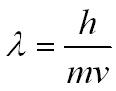
From these two seemingly small things, some very clever people were able to draft up the theory of what we know as the wave particle duality, the idea that waves and particles can be equated as one thing in a similar way to how Einstein equated matter and energy. In order to do this, DeBroglie created a very interesting equation:
Which is in summary wavelength is equal to Planck's constant over mass times velocity. Or to the non physics people, waves and particles pretend to be each other.

What does this have to do with atoms you ask? Well many more equations were made until eventually we became able to actually write a particle as a wave of probability, stating effectively how much of the particle is there. And the particles we can do this with include electrons.

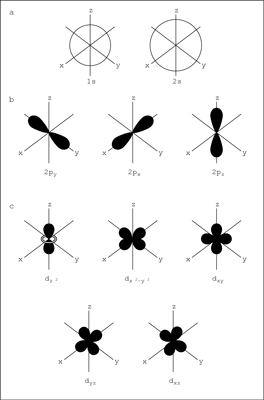
So last time I showed you the electrons in nice tidy orbitals, whereas the quantum model of the atom takes into account the fact that electrons could be wavey and makes it look like this instead:


image2.jpgAnd when there is more than one they will still repel, despite being merely a cloud of charge and will form all the pretty patterns on the right. depending on how many are present. to be as far away from each other as possible, much like two arguing siblings.

And that is how simple the quantum model of the atom gets, well now hopefully you understand atoms just a little bit better now.

You know whats a weird thought? Just how complex such an incredibly small system can even be, there was a time that the atoms were thought of as indivisible, but over time we have come to discover that even these tiny little bits of stuff are even more unimaginably complex than we could ever manage to completely understand.

Once again it has been a pleasure writing and thank you all for reading, see you soon :)

Sunday, 1 November 2015

A Journey to the Centre of the Atom - Part 1

HELLLLOOOOO INTERNEEEEEETTTTTT!!!! I have missed you guys but now I'm back and had a pretty interesting idea for a couple of more posts!

For anyone who doesn't know, I'm a massive physics nerd. Physics is great, in some cases it knows exactly what's going on and can predict is really accurately. But in other cases it can model something, but all that we really know for certain is how little we really know about the topic, and one of the most famous cases of this is the atom.

Humans seem to love making things, our creativity is one of the things that defines us, setting us apart from the bacteria and fungi that we share this planet with. But there have been times where in order to make new things, we have had to have a greater understanding of what we're making them out of.

We have always been looking closer and closer, building microscopes to detect light and even electrons in an attempt to figure out what everything is made of, probing deeper and deeper, trying to find the indivisible individual sections of matter that make up everything. The atom may not be the simple individual piece that we're looking for but it is a truly beautiful system, made up of a complex structure of matter and balanced charges.

In this post I'll explain the classical model of the atom, where we assume everything is all nice and tidy and made of particles and not a quantum mess of clouds of charge and such.

So lets begin with the biggest part, the atom itself, the largest atom known to us is that of Cesium (CS) which has a radius of around 270 pm. Lets put that in perspective, 1 pm is 1x10^-12 m or in an easier to understand format, 0.000000000001 m that means that one of these atoms is 0.000000000540 m across. Pretty small right? Guess again because that's not as small as an atom gets, the smallest atom possible is that of helium, with a minuscule radius of 31 pm, nearly 9 times smaller! OK fine that's really not that much smaller in the sense of things, until you realise that's the difference between the Arc De Triomphe and the Empire State Building!

So that's how big they are, or more accurately how small they are, I mean there's more atoms in a grain of sand than there are grains of sand on Earth!

Anyway moving on, next layer, AKA the electrons! Who doesn't love electrons? They power our gadgets, they're thought to be fundamental particles, they do all kinds of cool stuff with light and charged particles and they supposedly orbit neatly in shells of 2, 8 and 8 right? Wrong.

Electrons are great little things, but they are by no means straightforward. The fact that they repel means that when they are orbiting an atom they take up positions that will allow them to be as far away as possible from the other, so one is fine by itself, two will be on opposite sides of the nucleus, three will be in a triangle and 4 will be a tetrahedron and so on and so forth.

The chart on the right is a bit of a preview to next time but also shows just how incredibly complex these seemingly simple little lumps of negativity can be.

And it only gets weirder.

Now on to the next part of the atom, the nucleus, a region which is so dense that if we could fill 1 cubic meter with the nuclei of atoms (they're all roughly equally dense) it would weight roughly 2.7x10^17 kg, which is equivalent to 77500000000 Saturn V rockets. ItIhelps to visualise to say that if the moon was compressed to this density from its current average density of 3347 kg/m3 then it would have a new surface area of 22600 meters squares, roughly the size of 1 quarter of Ireland. So yeah its pretty incredibly dense, and as the electron's mass pales in comparison we tend to just say that the mass of the nucleus is the mass of the atom.

But now we must leave out electrifying friends as we have to go deeper!

Anyone who has done GCSE physics will know that the nucleus contains protons and neutrons, the positively charged particles that keep the electrons around and the neutral particles really don't do much more than add more mass and stability to the nucleus.

But lets look a little closer shall we? Firstly the proton. This particle is the optimist of the atomic trio, constantly positive with a charge of +1. Its is also spinning constantly as are all of the particles, and as it is spinning, the motor effect dictates that a small magnetic field is generated. And that is pretty much it, it is also interesting to note that as a hydrogen nucleus is simply 1 proton by itself, we find a lot of protons simply floating around as either Hydrogen atoms or alone as Hydrogen + ions.

Secondly the neutron, this is actually sightly more simple than the proton, the neutron consists of quarks which have charges that actually balance out to 0 making it a completely neutral particle (hence the name). The neutron just kind of sits there, spinning around and adding a bit of mass, sometimes it may influence the spin of an electron but that is really one of the only significant effects that the particle has.

However when we look at what happens to the system as a whole under different circumstances, it gets a lot more interesting, for example, while the strong force can easily bind together a nucleus with the same amount of protons and neutrons, once there is an imbalance, things start to get a little bit tricky. Through quantum mechanical processes, the nucleus can literally beak apart over and over again, emitting alpha particles (helium nuclei) until it is eventually stable enough to bind the particles together better. We call this radioactive decay (although there are two other types that occur in different ways to this one).

Does anyone think this is as small as things get? If you did then you're completely wrong and need to remember that physics does not comply or cooperate with us willingly. Ever. Scientists in the late 60s decided they wanted to see what was inside these particles, so naturally they got a big particle acceleration machine and smashed things into each other until they found their answer. (yay physics!)

What they found was extremely interesting, when you fire an electron at a proton with enough speed it will actually go through the proton, however it is deflected by what appear to be 3 point charges within the proton. The same applies to the neutron. The physicists who predicted this before the experiments were carried out had creatively chosen the name "Quarks" pronounced "kworks" as opposed to a traditional physicsy name like subnucleonic particles, which is frankly refreshing considering how wildly creatively science as a whole has named most things (yes I'm talking about you chemistry with all of your naming systems!).

Quarks make up protons and neutrons, there are 6 flavours of quark called up, down, strange charm, top and bottom, they all possess a charge of either 2/3 or 1/3 (positive or negative) and they also posess colour charge because normal charge is not enough for them, and as a result of this, cannot exist alone and I swear that I did not make up any of that, those are actually the correct names and terms.

Personally I'm looking forward to the names that they will come up with for more advancements in this field just as much as the science itself!

At the moment we have no idea what is inside a quark, for all we know it might be fundamental, and until we can prove it experimentally we have no clues other than theoretical maths created to support theories. However physicists at the Large hadron Collider (LHC) are doing exactly that, being unsure if the LHC can actually provide enough energy to break a quark into bits, they are instead aiming to make one excited (energetic) in the hopes that they can tell from the energy emissions whether or not it has a substructure.

And there we have it, from atomic radii to quarks, that is the nuclear model of the atom, which is surprisingly not able to explain everything, considering the amount of detail it consists of. But anyway whats a story for next time.

If any of you saw the date yes I did spend lots of Halloween typing this but I already went to Halloween party this week and can't cope with continuing my walking dead marathon at night when its dark so don't judge me!

Anyhow its getting late and I am tired so I'll leave it there for today, has it occurred to you yet that particle physicists are a bunch of atoms trying to understand themselves? Yep our universe it that awesome and weird and clever and generally crazy.

On that note I shall leave you all once more, Happy Halloween to you all and I'll post again soon! :)